I’ve never understood pilots who feel the need to rotate during takeoff at a rate that can only be described as “jerking the aircraft off the runway.” Even more perplexing, is that many of these pilots fail to respond to my critiques. They often do as I requested, I suppose due to my greater seniority or maybe just as a way of getting me to shut up. But more times than not, they return to form. I know part of the problem is that I tend to jump right into the aerodynamics and then graduate to accident case studies. Perhaps you’ve had the same experiences.
— James Albright
Updated:
2026-07-01

Airbus tailstrike unstick test (airliners.net)
We'll cover two accident case studies but if all you do is read them, you will have missed the primary lesson. This is one of those things where many pilots react with, "Yeah, I know that" but then go one with the ways their muscles memory dictates. I've also tried diving into the aero lesson first, and eyes glaze over. So this time, we begin with a few stories instead.
1 — The mighty KC-135A “Strato Pig”
3 — AOA, pitch angle, and that pesky relative wind
4 — An aircraft manufacturer gets it right, then wrong, then right again
5 — Case Study: Challenger 604 C-FTBZ
1
The mighty KC-135A “Strato Pig”
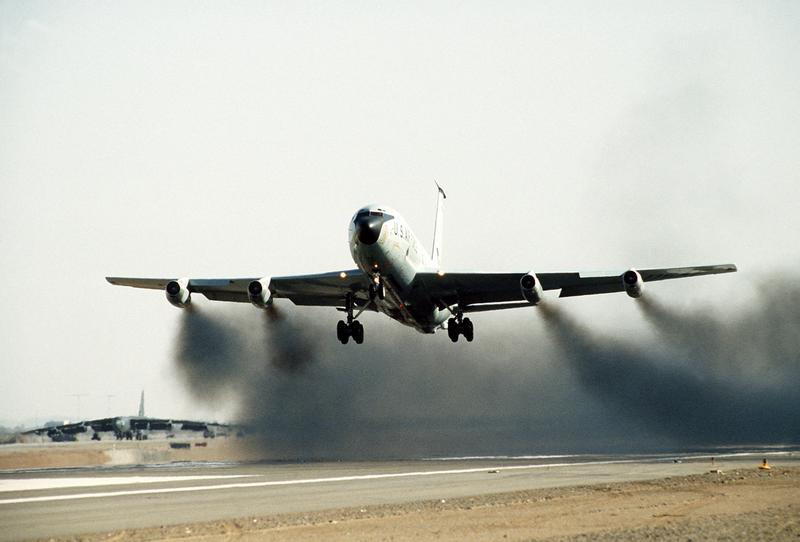
KC-135A water injection takeoff
I think the original KC-135 Strato Tanker was a fine aircraft for its time, the 1950s and 60s. Given the technology, it is a marvel the aircraft could do so much with so little. To appreciate how little, let’s do a pop quiz about your airplane’s thrust-to-weight ratio. Yes, that tends to be the domain of the latest hot fighters, but let’s give it a shot in the category of modern transport category aircraft. For example:
Boeing 777
Typical maximum gross weight: 775,000 lbs.
Typical maximum total thrust: 230,000 lbs.
Thrust to weight ratio: 0.30 to 1
Gulfstream GVII-G500
Typical maximum gross weight: 79,600 lbs
Typical maximum total thrust: 30,200 lbs
Thrust to weight ratio: 0.38 to 1
KC-135A (earliest variant)
Original maximum gross weight: 275,000 lbs
Typical maximum total thrust (with water injection): 52,000 lbs.
Thrust to weight ratio: 0.19 to 1
Just for grins, the F-15C
Typical maximum gross weight: 68,000 lbs
Typical total thrust: 58,000 lbs
Thrust to weight ratio: 0.85 to 1
At some weights with less fuel and without payload, the F-15C has a thrust to weight ratio of greater than 1.2 to 1.
So, yes, the KC-135A was underpowered. I once took off from Anderson Air Base in Guam at maximum gross weight. The routine was to taxi onto the runway while at the end of the runway so as to have as much runway ahead of you as possible. Both pilots would stand on the brakes. The pilot would set takeoff thrust without the water injection, the copilot would engage the water injection and yell out a countdown – the noise was unbelievable – “Three, two, one, release brakes!” And then, nothing. The aircraft would not move at first. I used to rock in my seat back and forth, as if trying to push the airplane over its chocks. Nobody else in the cockpit thought this was funny. And off we would go, sometimes taking all 12,000 feet of the standard SAC runway. But that was only half the battle. The other half was rotation rate.
We were told that we had to rotate at exactly 3° per second to 8.5 degrees. Deviate, and you may not make it off the runway. I heard stories where the pilots rotated too quickly and didn’t make it off the runway. By the time I got to the airplane, the KC-135A had been operational for 23 years and 50 were lost. Twelve of those loses were during takeoff, with rotation rate listed as causal at least twice, but may have been a factor in other incidents. Flying the airplane, you often witnessed the anemic climb performance and at times could sense it sluggishly clawing the air for lift. But proper rotation rate was beaten into us and the only time I witnessed the ill effects of too fast a rotation was in a more powerful airplane with a less powerful pilot . . .
2
The mightier EC-135J
The next big aircraft for me was the EC-135J, a Boeing 707 variant with a larger wing and more powerful engines than the KC-135A. We were also heavier, but the airplane seemed to leap into the air by comparison. So, I stopped worrying about rotation rate, though I always stuck to 3° per second. Then one day, at Barbers Point Naval Air Station, Hawaii, I came close to becoming one of those fireballs at the end of a runway.
By this point, I was an instructor pilot for the first time, I was twenty-nine-years-old, and thought I was indestructible. My assignment for the day in question was to introduce a one-star general to the wonders of four engine heavy aircraft. He was an F-4 turned F-15 pilot with lots of hours for a fighter pilot, well over 2,000. (More than I had at the time.) I flew the takeoff out of Honolulu International from the right seat, just to help him warm up to the task ahead. We met up with a tanker, I did the receiver refueling for my own currency and coached him through the process. He was an experienced receiver pilot while sitting in his fighter but was humbled in our big jet. But that was to be expected. I was really worried about having him land the airplane at Barbers Point and briefed the procedure over and over. By the time we got to traffic pattern, I was still talking. The general did great, landing right in the touchdown zone, gently lowering the nose to the runway and pushing the power forward as I reset the flaps and trim for our touch and go. I called “rotate” and he pulled back on the yoke so aggressively that only then did I realize I never briefed the takeoff procedure.
The aircraft raced along the runway, the main gear on the runway, the nose in the air, and the airplane refusing to climb. I shoved the nose back onto the runway and then rotated at the required 3° per second. “She ain’t a fighter,” the general said. Hard to argue with that. So what happened? A quick lesson in aero is in order . . .
3
AOA, pitch angle, and that pesky relative wind
We’ve heard the definition over and over: AOA, angle of attack, is the angle between the wing’s chord line and the aircraft’s relative wind. But what does the chord line have to do with the aircraft’s pitch? The angle the wing is mounted onto the fuselage (the angle of incidence) gets in the way. What is the relative wind? It’s just the opposite of the aircraft’s flight path. How can an AOA, which our gauges give to us as decimal numbers between 0.0 and 1.0, and sometimes a little more, how can they be angles? They are, but what we see in our cockpit indicators are “normalized” into ratios, sort of, and are not actually angles.
For our purposes here, let’s simplify all of that. Our AOA is the angle between the chord line and the flight path. We’ll accept that the aircraft’s pitch may not equal the chord line, but they are related, so we’ll use that as compared to the normal rotation angle for takeoff. We won’t specify any angles at all, since those will be dependent on the aircraft. Instead, let’s just look at how our takeoff rotation can end up in a stall. First up, consider the airplane accelerating down the runway, just prior to rotation speed and the pilot’s initial pull on the stick or yoke.
Acceleration, prior to rotation speed
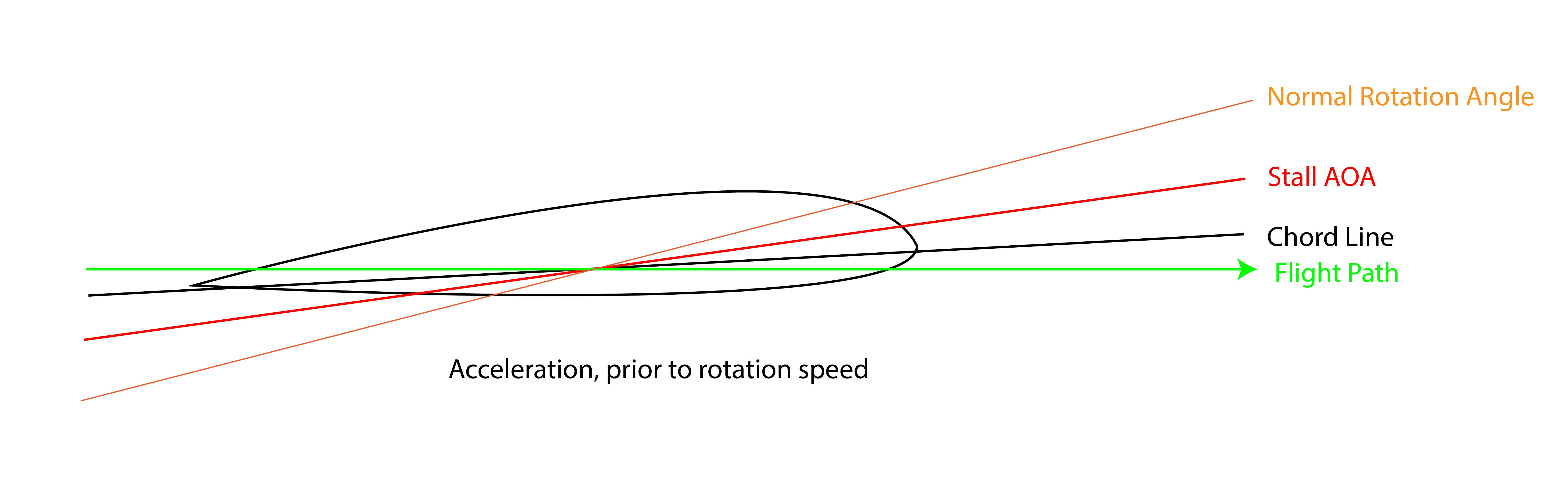
There will be a range of speeds during takeoff where you do have some pitch authority, but not enough to fly. Pull the stick or yoke back, the aircraft’s nose will come up, but you aren’t flying yet. You have to wait for rotation speed. From the perspective of the wing, the flight path is horizontal, along the runway. For most aircraft, even with all the landing gear firmly on the runway, the chord line will be slightly positive. The stall angle of attack is less than the normal rotation angle. That’s why you cannot fly yet.
Initial rotation, prior to unstick

As you start to rotate the nose of the aircraft upward, but before what aircraft designers call “unstick,” the point where the airplane becomes airborne, the chord line moves up and gives you a positive AOA. The stall AOA is still below your normal rotation angle, but the stall AOA is moving upward. Notice that the flight path hasn’t changed and that is a key point here: the flight path lags the chord line.
Normal rotation, halfway

How long should your rotation take? Of course you should pay attention to your aircraft manuals, but take a look at a caveat below, “An aircraft manufacturer gets it wrong (at first).” But generally speaking, most aircraft should be rotated at three to four degrees per second. So, if you need to rotate 15° during takeoff, that should take between four and five seconds.
If you rotate at the correct rate, the chord line increases gradually and with it so does the stall AOA and the flight path. In our example drawing, the AOA is positive, the chord line has made it to the normal rotation angle, but the flight path is still lagging behind.
Normal rotation, completed
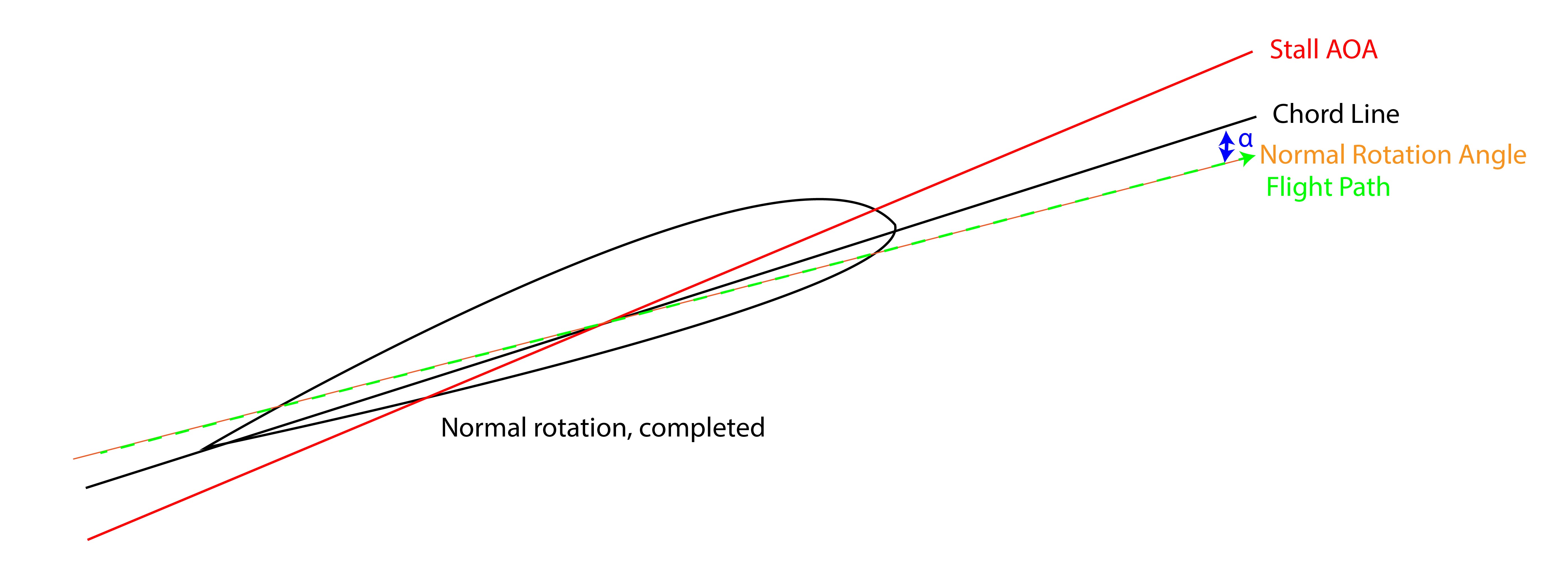
Giving the airplane a few more seconds, the flight path catches up and now you are climbing just as your performance manuals predicted. You have a positive AOA and a healthy margin below the stall AOA.
Initial rotation, rate too rapid
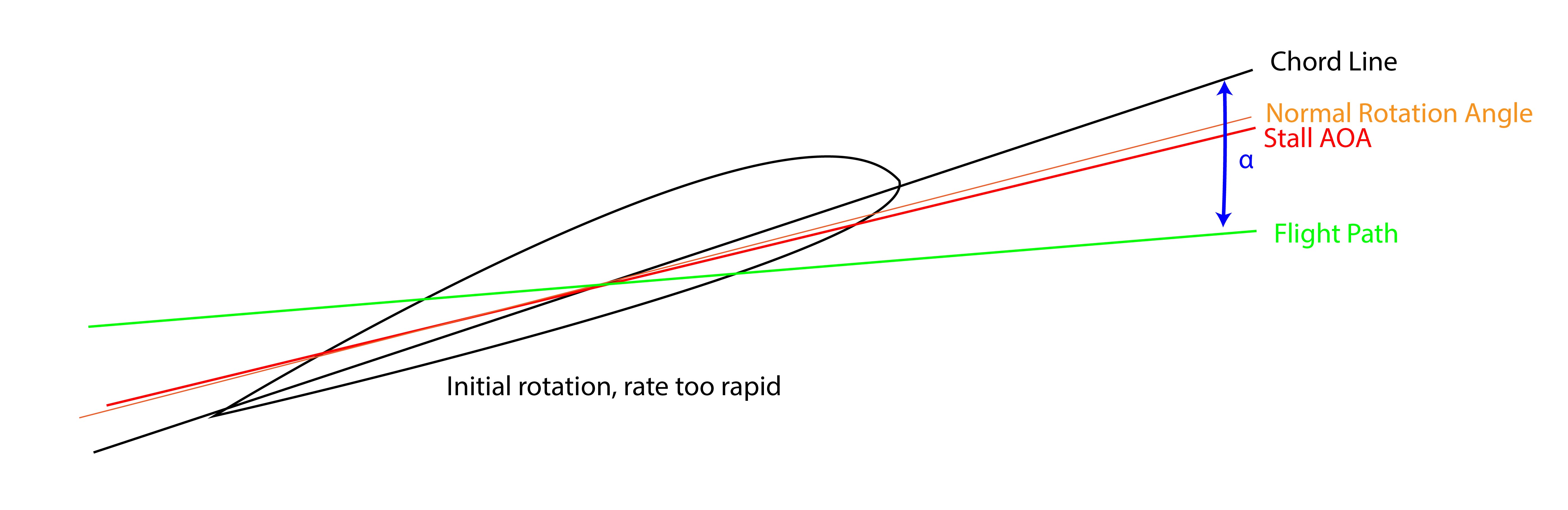
Remember that the flight path lags and that you can pull back on the stick or yoke so quickly, that your chord line exceeds the stall AOA. The flight path might even be positive, but you will be stalled. Remember also that your wings may stall at a different rate, so your initial climb may be with one wing moving up and the other heading for the ground. That is yet another reason to rotate at a reasonable rate, usually right around 3° per second.
4
An aircraft manufacturer gets it right, then wrong, then right again
My first experience with Gulfstream business jets was the Air Force version of the G-1159 (GIII), known as the C-20B. I went on to fly the C-20C and lastly the C-20A. Here’s what those manuals had to say about the takeoff rotation:
At VR, the pilot smoothly initiates rotation of the aircraft to takeoff attitude, (normally 10° to 12°) reaching V2 at approximately 35 feet. Takeoff attitude should be accomplished in approximately 4 seconds. This movement of the control column should be smooth and sustaining rather than abrupt.
Source: T.O. 1C-20B-1
Most of our pilots came from larger aircraft and this rotation rate fit with our experiences, about 3° per second. We just continued to do what we did in the bigger jets. I went on to fly the civilian versions of later Gulfstreams, including the GIV and GV, which simply said something along the lines of, “follow the flight director commands,” which also rotated at the sane 3° per second. Then came the next generation, where we were treated with this:
After reaching the target rotation speed, a rapid and aggressive column pull shall be applied. Adjust pitch following liftoff to achieve V2 at the 35 foot height. The takeoff performance presented in this section is predicated on employing the following techniques during rotation and climb out following an engine failure. After reaching the target rotation speed, a column pull force of approximately 75 pounds should be applied in an aggressive manner (less than 1 second).
Source: G450 AOM, Section 12-01-10, Paragraph 1 (old version, around 2010)
Why the change? I suspect it was all an effort to drive down V2 speeds to achieve better field performance. Saying your 80,000 lb. jet can operate out of a 4,000-foot field sells airplanes, after all. But all that changed in 2011 when a test Gulfstream G650 crashed during takeoff following just such a rapid control column pull. The crash itself was caused when the aircraft flew out of ground effect at too low a speed trying to achieve a V2 that was too low for the conditions. But it became obvious that a normal rotation rate would have prevented the crash.
To its credit, Gulfstream revised its G650 numbers, its flight test procedures, and its prescribed takeoff rotation procedure. From the last Gulfstream I flew:
At VR, smoothly rotate to establish an initial pitch attitude of 10° in 3-4 seconds. Maintain 10° pitch attitude until confirmed in-air, and it is necessary to adjust pitch and capture desired climbout airspeed.
Source: GVII-G500 AFM, Section 05-05-00, p. 2. (Initial issue)
The stop at 10° is presumably to prevent a tail strike, but in practice the rotation is one smooth movement to between 15° and 20°, all at around 3° per second. Perfect.
5
Case Study: Challenger 604 C-FTBZ
Why do some pilots have the urge to snatch the yoke or stick back as if the change from a three-point to a takeoff attitude was a race? I used to call this the “Top Gun Wanna Be Syndrome,” these pilots thinking it macho to do everything “at the speed of heat.” But after having flown with a few such pilots, I think it is just a poor understanding of aerodynamics. For example, at least a few pilots hired by Canadair back in the year 2000, given a few weeks of training, and christened with the title “test pilot.”
Date: 10 October 2000
Time: 1452
Type: Canadair CL-600-2B16 Challenger 604
Operator: Bombardier Aerospace
Registration: C-FTBZ
Fatalities: 3 of 3 crew, 0 of 0 passengers
Aircraft Fate: Destroyed
Phase: Takeoff
Airports: Wichita-Mid-Continent Airport, KS (ICT), USA
This particular Canadair test crew was doing takeoffs with aft Center of Gravity (CG) loaded on their Challenger 604 and official word from Canadair was there was fuel migration from forward to aft tanks and that was the cause. End of story. I was flying the same aircraft type at the time and immediately knew this cause was bogus. Apparently, the NTSB had the same thought and reopened the case after Transport Canada pronounced the cause final.
Before I go on, let me acknowledge that the CL-604 has the most complicated fuel system I’ve ever used, and I used to fly the KC-135A tanker! Take a look at this:
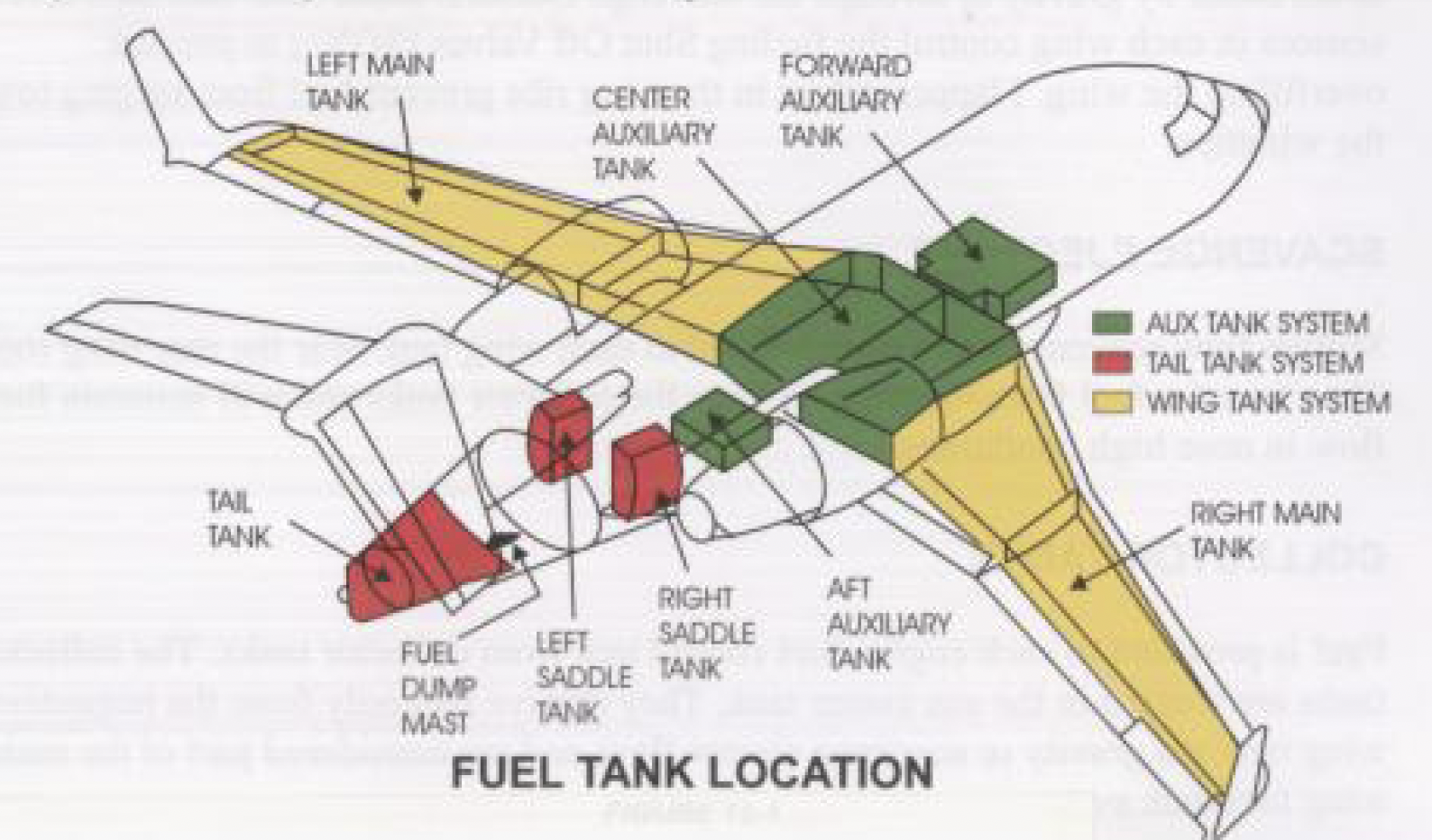
CL-604 fuel system (NTSB AAB 0404, fig. 1)
It is possible to “fill it up” on the ground outside of CG limits. (In fact, there was later a crash of a 604 from this very cause: https://code7700.com/case_study_cl-600_n370v.htm.) But to those of us checked out in the aircraft, having enough fuel migrate during the takeoff run from in balance to out of balance was hard to believe. The NTSB came to the following conclusions:
The National Transportation Safety Board determines that the probable cause of this accident was the pilot's excessive takeoff rotation, during an aft center of gravity (c.g.) takeoff, a rearward migration of fuel during acceleration and takeoff and consequent shift in the airplane's aft c.g. to aft of the aft c.g. limit, which caused the airplane to stall at an altitude too low for recovery. Contributing to the accident were Bombardier's inadequate flight planning procedures for the Challenger flight test program and the lack of direct, on-site operational oversight by Transport Canada and the Federal Aviation Administration.
Source: NTSB Aircraft Accident Brief, AAB-04/01
Though the NTSB probable cause talks about excessive takeoff rotation as well as fuel migration, it doesn’t mention the rotation rate. The body of the report, however, does.
Let’s consider the fuel migration first. How much fuel migrated from forward to aft? The NTSB reported Canadair’s claims which amounted to the movement of 27.2 gallons from the forward, center, and saddle tanks to the aft auxiliary and tail cone tanks. I don’t buy that the fuel moved at all; I think it is more likely that fuel quantity indicators within each tank reported erroneous values when the fuel moved aft within the tank during acceleration. But let’s say 27.2 gallons did indeed move. Using the report’s fuel density figure of 6.75 pounds per U.S. gallon the shift amounts to 183 pounds. In my opinion, for an aircraft that weighed 45,254 lbs, this is unlikely to affect the CG to the point it exceeds elevator authority. [Figures based on NTSB report, pp.8 – 9.]
This report came out in 2004. Two years earlier, I flew with a Canadair test pilot to validate a flight control change in our aircraft. As we prepared for the flight, I was alarmed that the test pilot didn’t have a plan and didn’t understand what was needed to test our repaired elevator system. I reluctantly ceded the left seat and we set off. During the takeoff rotation, he snatched the yoke back so aggressively that I feared a stall and pushed forward. I told him a 3° per second rate was required. “Where does it say that?” he asked. “It’s in the AFM written by the company that pays you.”
When the report came out, we found out that more than a few of these test pilots liked to snatch the yoke back aggressively, in some cases as high as 9 degrees per second, three times the prescribed rate. The accident pilot did this routinely. Why?
The pilot
The 33-year-old pilot “performed avionics certification flights for an avionics manufacturer” in 1989 and 1990, then went on to be a captain on an Aero Commander 500 flying 14 CFR 135 cargo operations, during which time his ATP was suspended for failing to secure his cargo. He was later hired by Bombardier Aviation Services in Tucson, AZ as a certification test pilot, flying the Learjet 31A, Learjet 60, and Challenger 604. He was hired as an experimental test pilot by Bombardier in 1999. [NTSB Aircraft Accident Brief, AAB-04/01, p. 4]
The NTSB reviewed the pilot’s previous takeoff performance and found a pattern of faster than prescribed rotation rates, including 7.2° per second on a previous test flight, 6.0° per second on a ferry flight. [NTSB Aircraft Accident Brief, AAB-04/01, p. 17]
In my view, the pilot was unqualified for his duties as he was hired, but that can be made up for with proper training.
Training
At the time of the accident, Bombardier production and experimental test pilots attended initial and recurrent training alongside regular customers with no test scenarios presented. “Company flight test training is on-the-job,” where maneuvers are demonstrated to pilots and then the maneuvers are performed by the pilots being trained. The report says that Bombardier sends its test pilots to a 2-week flight test short course at civilian flight test school. Contrary to this statement, “The chief test pilot stated that pilots did not receive external test pilot training and that they did not use the company’s simulator for flight test training.” [NTSB Aircraft Accident Brief, AAB-04/01, p. 22]
The manager of flight test operations and safety assessed the flight’s risk level as low because the airplane was operating within its c.g. range and because “the modification was stabilizing.” The crew briefing prior to the flight did not include flight test maneuvers and procedures to address potential anomalies. [NTSB Aircraft Accident Brief, AAB-04/01, p. 3]
The accident flight
The flight was brief:
At 1448:45, the tower issued a takeoff clearance and instructed the flight crew to fly a heading of 230°. At 1449:21, the pilot stated, “okay, here we go,” and a sound similar to an increase in engine RPM was recorded 2 seconds later. At 1449:29, the pilot stated, “set thrust,” and the copilot responded, “thrust set” 6 seconds later. At 1449:37, the copilot called out “airspeed’s alive eighty knots.” At 1449:48 the copilot called out “V one” (takeoff decision speed) and “rotate”. The pilot responded, “okay, we’re flying,” followed by the copilot calling out “V two” (takeoff safety speed).
At 1449:51, the CVR recorded a sound similar to stick shaker for 2.2 seconds, during which time the pilot stated “whew,” and the flight test engineer stated “what are you doing?” The CVR then recorded the mechanical voice warning “bank angle” and a sound similar to stall aural warning for 1.1 seconds at 1449:53. “Bank angle” was recorded at 1449:54 and again at 1449:55. A sound similar to stick shaker was recorded for 0.15 seconds beginning at 1449:57, followed by “bank angle” again at 1449:57.36.
At 1449:58, and for the next 2 seconds, a sound similar to stick shaker was recorded for 0.22 second, and the pilot stated, “hang on.” A sound similar to stick shaker” was recorded again for 0.3 seconds, the flight test engineer repeated “what are you doing?” followed by a sound similar to stall aural warning for 0.82 seconds, and “bank angle” again. At 1449:59.59, the pilot stated, “hang on.” The recording ended at 1450:00.
Source: NTSB Aircraft Accident Brief, AAB-04/01, pp, 3 – 4.
Company culture
Since our focus here is rotation rates, I’ll just briefly mention a few company culture items and commend you to read the full accident report, which is only 32 pages, for more. I’ve already mentioned the lack of serious test pilot training. The report also covers the company’s lack of flight test oversight, failure to incrementally train pilots from routine to truly complex missions, failure to “build up” to the test maneuver, or to even discuss the impact of pitch rates on the maneuver in question. [NTSB Aircraft Accident Brief, AAB-04/01, pp, 29 – 30]
While there is value to having pilots learn “on-the-job,” there needs to be constant follow up to ensure the lessons learned are used and that pilots don’t revert to previous behaviors to become complacent. The accident pilot was not alone in his tendency to rotate too quickly:
Safety Board staff review of Bombardier flight data from 50 flights flown by BFTC pilots, including several senior test flight and management pilots, indicated that pilots routinely commanded pitch rates that were more than double the recommended rate of 3° per second during operational takeoffs. Company flight operations data, collected from every Bombardier test flight and archived, is not reviewed as part of an overall company flight operations quality assurance program. Therefore, this high pitch rate practice, and its potential for hazard, was not identified by senior Bombardier management.
Source: NTSB Aircraft Accident Brief, AAB-04/01, p. 30
To this day, many Challenger pilots talk about the “fuel migration problem” but not about rotation rates. Transport Canada and the NTSB missed an opportunity to elevate rotation rate from what most pilots consider an optional technique into a mandatory procedure.
6
Case Study: Saurya Airlines Flight SAU-FER
On July 24, 2024, a Saurya Airlines Bombardier CRJ-200 crashed after takeoff, killing all but one of the 19 people on board. It was a maintenance check / ferry flight and the aircraft was overloaded, resulting in erroneous V-speeds. The captain was startled during takeoff and rotated too aggressively.
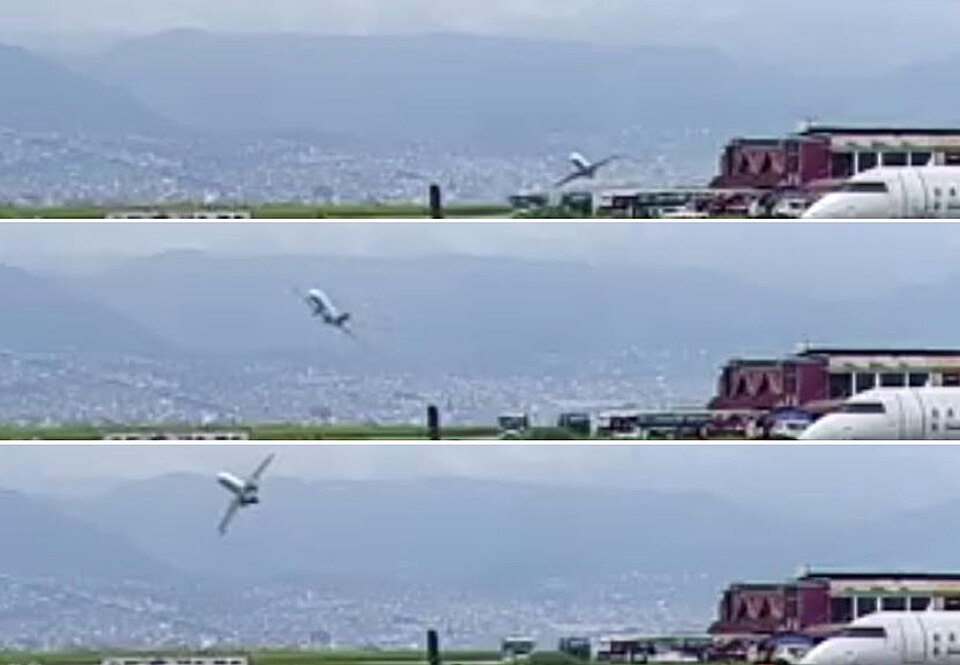
Tribhuvan International Airport CCTV via Aircraft Accident Investigation Commission - FINAL REPORT ON ACCIDENT INVESTIGATION of 9N-AME (CRJ 200LR, MSN 7772)
The most probable cause of the accident was a deep stall during take-off because of an abnormally rapid pitch rate commanded at a lower than optimal rotation speed.
The contributory factors to the accident are:
Incorrect speeds calculated based on erroneous speed card. The interpolated speed card of the operator for 18,500 kg TOW mentions incorrect V-speeds for take-off. This error in the speed card went unnoticed since its development. There was no acceptance/approval of the speed card booklet.
Failure to identify and address multiple previous events of high pitch rate during take-off by the operator.
The operator showed gross negligence in complying with the prevailing practices of ferry flight planning, preparation and execution. There is a lack of consistent definition of ferry flights.
Gross negligence and non-compliances by the operator during the entire process of cargo and baggage handling (weighing, loading, distribution and latching), while violating the provisions of operational manual and ground handling manual. The load was not adequately secured with straps, tie-downs, or nets, while the flight preparation was rushed.
Source: Accident Report Synopsis page
Date: July 24, 2024
Time: 1113 Local
Type: Bombardier CRJ-200ER
Registration: 9N-AME
Fatalities: 18 / 19 occupants
Aircraft fate: destroyed
Location: Kathmandu-Tribhuvan Airport (VNKT), Nepal
The captain was 35 years old at the time of the accident. He had accumulated 6,185 hours total time, of which 4,922 was in type. The first officer was 26 years old. He had accumulated 1,824 hours total time, of which 1,602 was in type. [Report, Section 1.5]
The aircraft was a Bombardier CRJ-200LR, manufactured in 2003. The aircraft had just completed a maintenance (C-check) at Pokhara International Airport’s hanger. The aircraft had been grounded for 34 days prior to the event flight. [Report Synopsis page]
The passengers were airline employees who loaded cargo and baggage throughout the cabin, without regard to weight and balance center of gravity or weight limitations. Investigators used aircraft acceleration data to estimate the takeoff gross weight to be 18,300±200 kg.
The first officer appeared to estimate the weight and then, using the airline’s Quick Reference Handbook tabulated data, computed a VR of 118 knots. The investigators noted that one of the QRH pages was a cut-and-paste from another page, resulting in an error in the V-speeds used by the first officer. This was cited as a contributing factor. While the error only amounted to 2 knots in the computed VR speed, the correct rotation speed considering the actual weight should have been 123 knots. [Report, Table 15]
The aircraft rotated near 120 knots with the elevator deflection going from 1.5° to 10° within 1 second, estimated rate was 8.6°/second. Two seconds later, the angle of attack of both wings reached 10° and the aircraft started to roll right to a maximum bank of 25°. Both aircraft in the Saurya Airlines fleet showed a tendency of the right wing’s angle of attack to consistently increase earlier than the left. [Report, Section 2.4.3]
During the commission’s analysis of prior rotation rates on the accident flight and a different CRJ-200 of the Saurya fleet, it was noted that the airline has a pattern of crew members performing take-offs well above the 3º per second rotation standard.
WARNING: Excessive rotation rates (exceeding 3° per second) or over-rotations may lead to high pitch attitudes and angles of attack being attained while the aircraft is near the ground. This can reduce stall margins significantly, resulting in stick shaker/pusher activation and potentially loss of control. Pilots must rotate smoothly towards the target pitch attitude then transition to speed control. [Report, Appendix 10]
The appendix goes on to catalog previous incidents in 2023 and 2024 where rotation rates exceeded 4°/second, listing 21 such events, with some as high as 5.8° or higher.
A lot went wrong on this flight that could have been survived. The aircraft was probably loaded well beyond maximum weight and center of gravity limitations. The erroneous takeoff performance numbers could be critical. But the accident would not have happened if the pilot employed a normal rotation rate. A few extra seconds would have given the aircraft’s flight path time to catch up and keep the rotation angle below the stall angle of attack.
7
Lessons Learned and Lessons to Apply
The wise old pilot’s warning to “Take ‘er easy” when it comes to takeoff rotation is indeed wise, and most of us heeded that warning as good sense. In many things aviation, smooth and gentle is better that rough and abrupt. But I hope I’ve added to that warning with the reasons why:
- Before you start moving, your target rotation angle is above the critical stall angle of attack, but you don’t have the pitch authority to get there, so no problem.
- As you accelerate, there comes a point where you do have pitch authority and you just might have the ability to raise the nose above the stall angle of attack, so don’t do that.
- It takes time for the aircraft’s pitch to increase and for the wing’s chord to follow. During these critical seconds the aircraft’s critical stall angle of attack is also increasing, following the wing chord. Rotating too quickly risks exceeding the stall angle of attack.
- Your wings may not stall at the same time and when that happens a roll develops. If you are at a low speed and close to the ground, you might not survive.
For most professional pilots, the 3° per second rotation rate is part of muscle memory and that’s a good thing. Going forward, there are cautions for these pilots as well as others.
- If your manufacturer specifies something around a 3° per second rotation rate, follow that.
- If your manufacturer doesn’t specify a rotation rate at all, 3° per second should work for you.
- If your manufacturer recommends an abrupt and aggressive rotation rate – as used to be the case at Gulfstream – push back, ask why, and recommend the 3° per second rate instead. If the aggressive rate was needed to meet takeoff performance numbers, take those numbers with a grain of salt.
- If you are flying with someone who ignores procedure or sound flying technique, tactfully suggest these recommended rates. Give them a copy of this article. Find someone else to fly with.
References
(Source material)
Final Report on Accident Investigation of 9N-AME (CRJ 200LR, MSN 7772) Aircraft Operated by Saurya Airlines Pvt. Ltd. on July 24, 2024, Aircraft Accident Investigation Commission, Government of Nepal, Ministry of Culture, Tourism and Civil Aviation, July 14, 2025.
NTSB Aircraft Accident Brief, AAB-04/01, Bombardier CL-600-2B16 (CL-604), C-FTBZ, Mid-Continent Airport, Wichita, Kansas, April 14, 2004
Please note: Gulfstream Aerospace Corporation has no affiliation or connection whatsoever with this website, and Gulfstream does not review, endorse, or approve any of the content included on the site. As a result, Gulfstream is not responsible or liable for your use of any materials or information obtained from this site.