This is one of those cases that has more to do with the pilots than aircraft type; the aircraft type has more than its share of accidents, to be sure, but that has more to do with the Air Force pilot training mission than anything else. This accident also has more to do with pilot psychology than pilot ability. The “pilot type” is where the root of the cause is for this accident. But you would never know that from the publicly released details. And ignoring the real problem will cause future accidents just like this. Or perhaps it already has.
— James Albright
Updated:
2026-01-01
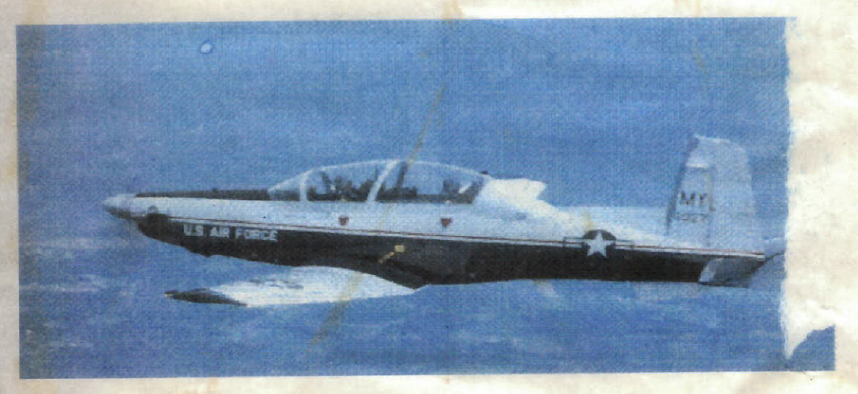
T-6A Texan II (AIB cover)
Here is the official Air Force news release:
RANDOLPH AIR FORCE BASE, Texas (AFPN) -- Published July 21, 2004
Air Force officials completed the investigation of a T-6A Texan II that crashed April 3 at the Savannah Hilton-Head International Airport in Georgia killing two Air Force pilots. The investigation determined the accident was caused by pilot error. The pilots, Capts [My redaction], were both assigned to the 39th Flying Training Squadron at Moody Air Force Base, Ga. The investigation board could not determine with certainty which pilot was flying the aircraft at the time of the accident. Returning from a training flight to Moody, the pilots had just lifted off when the accident occurred. For unknown reasons, the pilot flying the aircraft deviated from normal flight limits by exceeding the maximum bank angle of 90 degrees, and allowing the airspeed to fall below the minimum speed of 140 knots. The combination of the high bank angle and decreased airspeed caused the aircraft to stall and roll. No attempt was made to apply proper stall recovery procedures. As a result, the aircraft was nearly inverted at a much lower than normal altitude and was too low for safe ejection, the investigation found. The aircraft, valued at $4.2 million, was destroyed.
Source: Air Education and Training Command News Service
The phrase “for unknown reasons” is disingenuous at best. I got the Aircraft Accident Investigation Board (AAIB) report using a Freedom of Information Act (FOIA) request. The true reasons for the crash are certainly known, but embarrassing. Note that the AF news release named both pilots, but their names were redacted in the FOIA released report. I think there is value for all pilots in covering this accident in a narrative form, which I’ll do now.
1
A particular pilot mindset
I felt fortunate to have been taught to fly by several Vietnam War veterans, those who faced incredible odds and lived to brag about it. I was also fortunate to be indoctrinated into their heavy drinking lifestyles, as a demonstration of how alcohol can lower the I.Q. of even the best pilots. That was in 1979 at Williams AFB, near Phoenix, AZ. We had an officer’s club with two bars. The base pool had beer vending machines. Beer was sold at the billeting office. “Beer call” was a tradition and usually took place every Friday evening at the officer’s club. I was at one of the bars with a classmate who was too drunk to drive to or even find his on-base quarters. I couldn’t drive either, but at least I could navigate. I walked him to his quarters but along the way he stopped to vomit onto someone’s very nice cactus garden. As he was heaving his guts out, a very nice man approached me and asked if my friend would be okay. “Yes, sir, I’m just making sure he gets home okay.” The gentleman said, “you do that, son.” The next morning, I retraced my steps to pick up my car and realized that nice gentleman was the wing commander.
This kind of behavior was not only tolerated, it was encouraged. How are you going to slip the surly bonds of earth in a million-dollar kerosene rocket unless you have that “balls to the wall” attitude and ability to drink and fly? Attitude. That’s what we called it: the “attitude check” at the bar. Pilots who didn’t show, didn’t have what it takes. That’s the way it was at the first few of my thirteen assignments in a twenty year military career.
Two years after the cactus incident, in 1981, the Air Force began what was called the “Alcohol Deglamorization Program." The idea was to change the military culture around alcohol use, especially the heavy-drinking norms that had historically been associated with pilots. Mandatory beer calls were replaced with voluntary events with non-alcoholic drinks available. We did see some changes, especially when it came to driving or operating under the influence. Pilots in my first two squadrons were allowed to keep their wings following DUIs. But after that, I was witness to several being thrown out of uniform. Commanders with more than a few people involved in alcohol-related incidents could see their performance evaluations suffer.
But beer refrigerators in the squadrons persisted. Mandatory beer calls went away, but beer was available at most squadron “off duty” functions. Things got better, but still . . .
2
That brings us to 2004
Date: 3 Apr 2004
Time: 0916L
Type: T-6A Texan II
Operator: U.S. Air Force
Registration: 99-3553
Fatalities: 2 of 2 crew
Aircraft Fate: Destroyed
Phase: Takeoff
Airport (Departure): Savannah-Hilton Head International Airport, GA
Highly qualified pilots
Both pilots were highly qualified T-6A instructor pilots with good reputations. There is no record of who was flying and the AAIB report I saw had both names redacted. The aircraft can be flown from either seat.
Mission Pilot 1 was an Air Force Reservist and a full-time pilot with JetBlue Airlines. He flew the T-6A approximately one week per month and had a solid reputation as an aviator. [AAIB, Summary of Facts, para. 11.a] He had over 2,900 military flying hours, over 2,400 civilian flying hours, 226.5 hours in the T-6A, of which 117.4 hours were as an instructor pilot. His most recent flight evaluations rated him “fully qualified.” The report says he was “highly respected as both an IP and an officer by his superiors, peers, and students he taught.” [AAIB, Summary of Facts, para. 8.a]
Mission Pilot 2 was a full-time Air Force Reservist. He had over 2,600 military flying hours, 556.3 hours in the T-6A, of which 399.8 were as an instructor pilot. His most recent evaluation showed “no discrepancies.” [AAIB, Summary of Facts, para. 8.b]
The day before
The day prior to the mishap, 2 April 2004, both pilots flew together in a military aircraft and performed several unauthorized aerobatic maneuvers and low-level flights in three different locations. They also performed several unusually aggressive closed traffic pattern maneuvers that exceeded operational guidance and limitations when they arrived at the Savannah Hilton Head International Airport.
Source: AAIB, Summary of Facts, para. 11.b.
The night before
Air Force rules covering the pilots dictated at least 10 hours of continuous restful activity prior to flight. Testimony indicated both pilots left a bar between 2300 and midnight. [AAIB, Summary of Facts, para. 9.e.]
The crash occurred on 3 Apr 2004 at 0916 Local time. It is unclear when pathology and toxicology tests were conducted, but these appeared to show any alcohol found in the victims could have been explained by “postmortem alcohol production by bacteria in the blood.” [AAIB, Summary of Facts, para. 9.c.]
The AAIB appeared to give the benefit of any doubt about alcohol levels in both captain’s pathology and toxicology tests, but did not ignore other evidence:
The available evidence indicates that the night prior to the aircraft mishap, between approximately 2000 and 2300, the [mission crew] consumed a considerable amount of alcohol. [Mission Pilot 1] consumed an estimated six to nine drinks, to include one martini, four to six 23 ounce Guinness beers and one or two shots of bourbon. [Mission Pilot 2] consumed an estimated eight to ten drinks, to include five to seven mixed drinks (bourbon and coke) and three shots of bourbon. There was no evidence to indicate that either [mission pilot] was a chronic drinker.
Source: AAIB, Summary of Facts, para. 9.d.
How long does it take to metabolize ten drinks? The rate for a healthy male in his twenties, of average build and height, is about 1.5 to 2.0 hours per drink. I think all available evidence shows that the alcohol in the victims could have been other than the postmortem alcohol production by bacteria in the blood. In my opinion, it seems the AAIB preferred saying it was pilot error as opposed to saying the culture of the Air Force encouraged alcohol abuse.
The crash
At 0911L, the [mission pilots], call sign Pujoe 39, requested to taxi from the 165th Airlift Wing Air National Guard north ramp to runway 27. While taxiing, Integrated Data Acquisition Recorder (IDAR) data indicates they performed all required checks, including the run-up check. They also requested one visual pattern before they departed VFR to the west. They were cleared on to hold at 0914 awaiting another aircraft's takeoff from the intersecting runway 36. The delay was also to prevent Pujoe 39 from encountering wake turbulence by creating 3 ½ minute spacing behind a 757 departure from runway 27. After the runway 36 departure, a Coast Guard helicopter was cleared for takeoff from the parking ramp and told to proceed east while remaining south of runway 27.
Then Pujoe 39 was immediately cleared for takeoff and told to make left traffic. The [mishap crew] took off, raised the gear and flaps and then flew at approximately 30 feet above the runway for 19 seconds according to the IDAR data. The [mishap aircraft] accelerated to 168 knots, abruptly pitched up 37 degrees while simultaneously rolling left and continued rolling left until reaching a bank angle of 131 degrees (nearly inverted). The [mishap aircraft] climbed to a maximum altitude of 530 feet above ground level (AGL). During the initial pull-up, the [mishap aircraft] reached 3.6 times the gravitational force (Gs) and tapered down to just over 2 Gs while the MA's nose continued to drop below the horizon. The [mishap aircraft] was in a stalled state with the ailerons showing right stick inputs but with left rudder inputs. Given the stalled condition, the ailerons proved ineffective and the rudder input caused the aircraft to roll further left and the nose to pitch down. As the nose continued to drop past 35 degrees nose low and with the aircraft in a stall, the Power Control Lever (PCL) was moved to the idle position. The nose continued to drop to approximately 45 degrees nose low while the aircraft remained in 130 degrees of bank. [Mishap pilot 1] ejected from the [mishap aircraft] approximately three seconds prior to impact, at an estimated altitude of 337 feet AGL. The [mishap aircraft] descended in a 45 degree nose down attitude until impacting the ground at a heading of 150 degrees magnetic.
The [mishap aircraft] impacted the terrain at 0916L on 3 April 2004 approximately 1,540 feet south of the midpoint of Runway 27 at 51 feet Mean Sea Level (MSL). The sum total of component parts were found at or near the accident impact site. The [mishap aircraft] impacted the ground in a nose low attitude, while nearly inverted (rolled left 131 degrees). It was descending when the front of the fuselage (engine and propeller assembly) impacted the ground, creating a circular shaped impact crater. The left wing tip contacted the terrain milliseconds prior to the nose impact, thus imparting a cart wheeling motion (rotation around the vertical axis). The impact crater measured six feet in diameter, and was 3.5 feet in depth. Propeller blades and the spinner assembly were found in the soft ground at the impact crater. The [mishap aircraft] entered the impact site with the nose 45 degrees below the horizon. The wreckage was found scattered in an east/southeasterly direction of 80-115 degrees magnetic, as measured from the impact crater hole.
Source: AAIB Summary of Facts, para. 4.
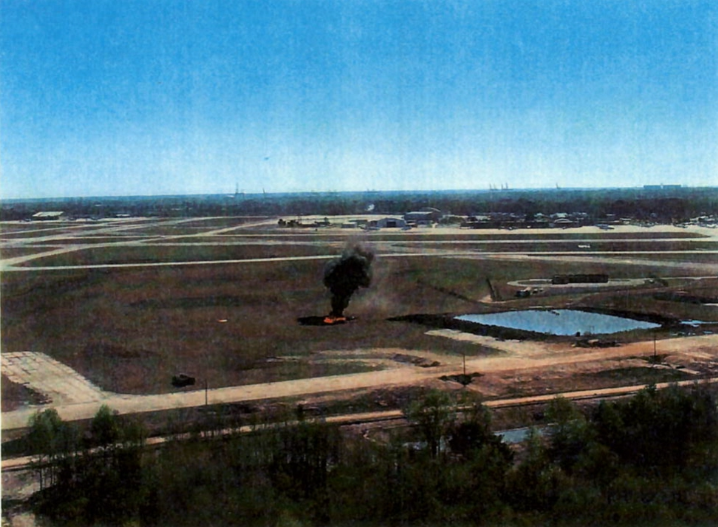
Crash site (AIB, Tab K, p. s-5
The AAIB offers the following as a statement of opinion:
Though unable to determine with certainty why the mishap crew performed a maneuver placing the [mishap aircraft] in a stall in the traffic pattern, there are several possible contributing factors: The [mishap crew]'s recent history of violating directives; their recent experience in successfully performing aggressive closed traffic patterns; and some level of impairment caused by over consumption of alcohol the previous evening.
Source: AAIB, Statement of Opinion, para. 2.
3
Young (mostly male) pilot culture (especially Air Force and Navy)
I think there is a tendency in Air Force and Navy flying squadrons to encourage the type of aggressiveness shown by the two pilots in this T-6A crash, and a willingness to look the other way when pushing (and exceeding) the limits of regulations, including those covering alcohol abuse. From my personal experiences and observations in the Air Force, this problem seems to be uniquely male, and almost always among young males.
I say “mostly male,” “especially Air Force and Navy,” and “almost always among young males,” when talking about the reckless nature of the flying and the tendency to abuse alcohol prior to flying. When it comes to documenting reckless flying, there are countless examples of professional pilots pushing the limits for no sane reasons. Just to mention a few:
The Air Force isn’t alone in its reluctance to address alcohol abuse among its pilots, but the life of a professional pilot encourages a culture of drinking while away from home. Long days coupled with nights away from home with easy access to bars “crawling distance” to hotel rooms makes it all too easy to get “knee walking drunk.” I’ve heard from multiple sources of at least one airline that arranges heavily discounted drinks at hotel bars as a price for their business. A quick look at recent news shows the pilot drinking culture is not limited to the Air Force, in at least two examples:
Southwest Airlines, Savannah (January 2025). A 52‑year‑old Southwest Airlines captain scheduled to operate Flight 3772 from Savannah/Hilton Head International to Chicago Midway was pulled from the cockpit on 15 January 2025 after a TSA officer reported smelling alcohol during crew screening. Police noted bloodshot eyes and a strong odor of alcohol, conducted field sobriety tests on the jet bridge, and arrested him on a DUI charge; the flight was delayed nearly five hours while a replacement crew was found, and the FAA later revoked his pilot certificate and Southwest ended his employment.
EasyJet pilot public intoxication (2025). In August 2025, an EasyJet pilot was removed from duty after an incident of public intoxication in which he reportedly behaved erratically and stripped naked prior to a flight, prompting questions in the press about how often such cases occur. The airline removed him from the flight and emphasized that safety procedures, including crew fitness checks and reporting mechanisms, are designed to prevent impaired pilots from operating commercial flights.
Are two examples in the last year enough evidence to say we have an endemic problem? No, of course not. But they do justify our concern.
4
Solution: “Patient heal thyself”
I think most of us pilots have varying degrees of ego that tell us we can push the limits and get away with it. From Tom Wolfe’s “The Right Stuff,” one of the best descriptions of pilot ego you can find:
All the hot young fighter jocks began trying to test the limits themselves in a superstitious way. They were like believing Presbyterians of a century before who used to probe their own experience to see if they were truly among the elect. When a fighter pilot was in training, whether in the Navy or the Air Force, his superiors were continually spelling out strict rules for him, about the use of the aircraft and conduct in the sky. They repeatedly forbade so-called hotdog stunts, such as outside loops, buzzing, flat-hatting, hedgehopping and flying under bridges. But somehow one got the message that the man who truly had it could ignore those rules – not that he should make a point of it, but that he could – and that after all there was only one way to find out – and that in some strange unofficial way, peeking through his fingers, his instructor halfway expect him to challenge all the limits.
The limits, you see, are for the other guys and gals, those who “don’t have it.” Those who “have it” often forget that they are not immune to the laws of physics, and quite often the results are tragic. Also, from “The Right Stuff,” a few pages later:
“Whiskey Kilo Two Eight, do you want to declare an emergency?”
This would rouse him! – to say: “Negative, negative, Whiskey Kilo Two Eight is not declaring an emergency.”
Kaboom. Believers in the right stuff would rather crash and burn.
5
Showing off
“Kaboom” is the key reason for avoiding the urge to show off at the bar and then in the airplane. Who are you trying to impress? There are two audiences: those “in the club” and those “outside the club.”
Those outside the club, non-pilots or those pilots aspiring to “climb the ladder” to where you are, will be impressed with the knowledge you fly jets and just seeing you hop in the airplane, start up, and takeoff will be thrill enough. They may join you at the bar, but after two drinks may start to wonder about how seriously you take the job.
Those inside the club, pilots flying what you are flying or at a level you aspire to achieve, will lose respect for you at the bar or watching any “hotdog” antics, because they understand better than you the risks. They also realize that this kind of behavior casts a shadow on them, and they won’t appreciate that.
One last thing that should weigh heavily on all professional aviators that is more of a factor today than it was back in 2004: social media. Your fellow bar patrons may be taking photos and videos of themselves, their friends, or even their meals. Your drunken self can be posted online and can come back to haunt you. That could be in the form of a future job interview, a review of your current job, or in an NTSB investigation. Stay professional, even off duty, and these won’t be a problem for you.
This sermon may be completely unnecessary for you. You might have the internal discipline to avoid showing off at the bar or the airplane. You might have the internal discipline and skills needed to simply do the right thing, all the time. But if you, like me, have your inner demons that need to be held in check, then the solution to this problem is clear. We have to remind ourselves that no matter what we are flying, the risks are always there, and the cost of failure is high. Our peers are watching for the example we set.
6
Postscript
Air Force discipline is like a pendulum that swings from one extreme to the other. The Alcohol Deglamorization program ended in 2017. I think the culture itself had changed, but not completely. We often joked that “there is always that five percent that never get the word.” Apparently, there are some Air Force (and non-Air Force) pilots that never got the word that alcohol and flying don’t mix.
References
(Source material)
Aircraft Accident Investigation Board (AAIB) Report, 3rd Flying Training Squadron, 479th Flying Training Group, Moody AFB, GA, 3 Apr 2004